MIRAN.DA INTERVIEW
On using your voice for good.
On a cloudy Friday morning two months ago, I set out to meet MIRAN.DA for a chat. The threat of rain couldn’t deter my excitement on the walk into town.
We met at the palm tree on a pole and settled into our semi-private seats in the alleyway next to Lee and Me. I sheepishly set-up my phone to record and appreciate the vines on the brick wall. One of the first things I ask is about her name.
“People were calling my Greenie for a little while, it didn’t feel right. I am very much Miranda so it felt weird being called anything else.”
Miranda! Was already taken - by a pretty big Argentine electropop band.
“I wanted something unique. I was just messing around and I was like oh - MIRAN dot DA”
I was curious if there was any inspiration from WILL.I.AM, whose name spells his URL. Not quite - but her parents are fans of another great poet of a previous generation - Shakespeare. The name comes from the Latin word mirandus, which means "admirable," "wonderful," or "to be admired".
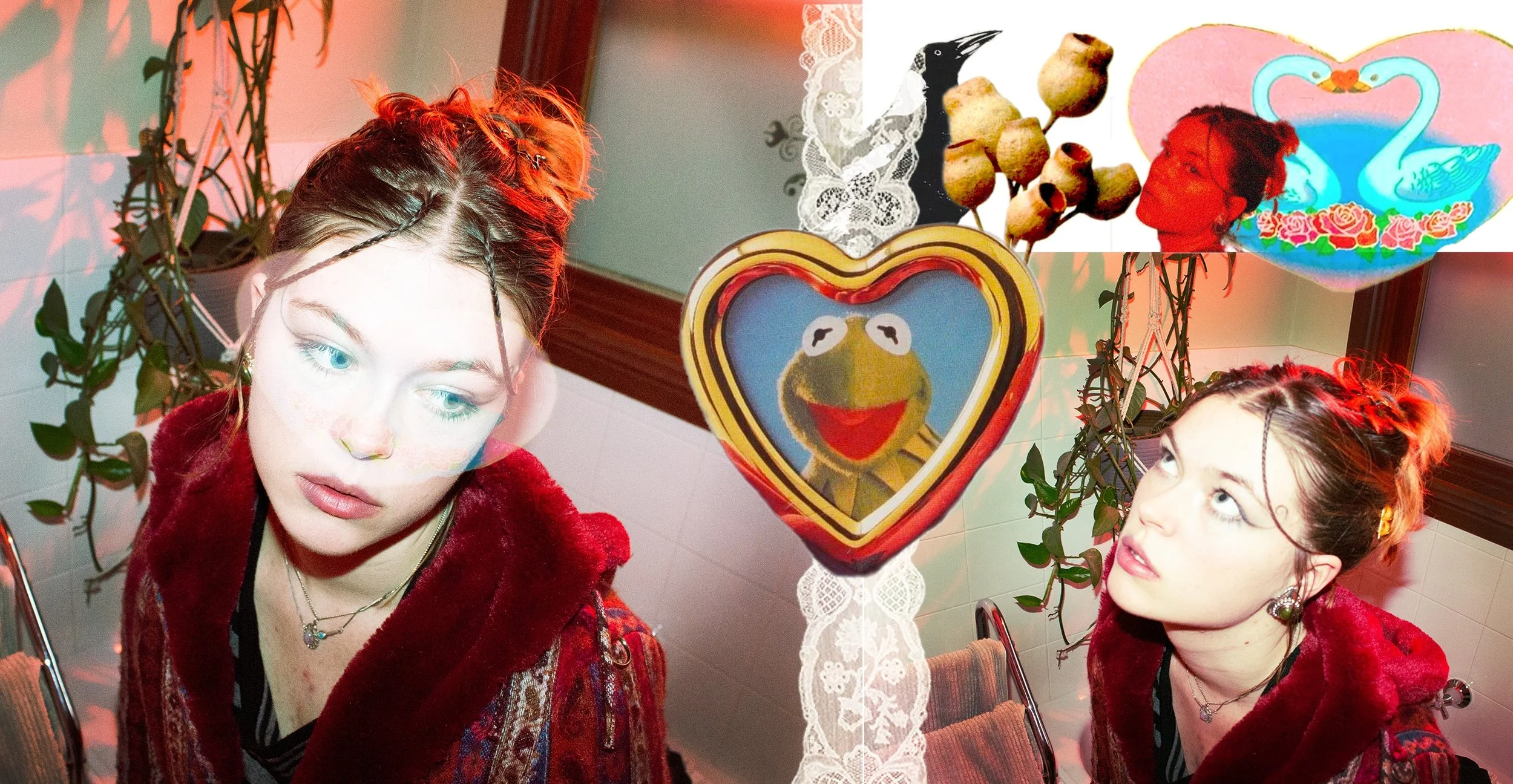
Her personal DIY motto is certainly something I admire. Along with being a singer-songwriter she produces all of her music herself, has a keen eye for graphic design, an acute thrifted fashion sense, she’s dabbled in animation, and editing her own music videos. A lack of a stage doesn’t stop her - she’s put on DIY shows everywhere from a Japanese inspired arcade to a rock climbing gym!
Miranda describes her song-writing process similar to writing a journal entry, a process that is separated over multiple days.
“I’ll be lying in bed about to go to sleep usually, and then a bunch of lyrics will come to me. I’ll usually write a lot more than I end up using”
“A vision will come to me about what they need to go with. And if it doesn’t, I just leave them alone.”
“I’ve always loved music. There’s one video on my Instagram with stamping things or painting and making lots of noise at the same time. Which is a pretty average Miranda kind of experience.”
Miranda spoke fondly of some of her early childhood memories growing up briefly in New Zealand.
“The best place ever.” “I kind of despised that fact that we had to move because I got bullied pretty badly when I turned up here.”
Miranda reminisces about a boombox that played CDs and cassettes.
“We had a few cassettes, I remember Rod Stewart. I would lie on the floor and listen to it and I was in love with him. I was a five year old.” “I had all these delusions about different artists.”
Miranda recalls even relating to the Amy Winehouse Back to Black album.
“Yes I have all this pain in my life which doesn’t exist” she jokes.
I’m convinced this is a sign of an emotional intelligence prodigy. She recalls being inspired by the sound of Winehouse’s voice, tone, and lyricism.
“She’s very honest, and I like that honesty.”
Another of her favourite records she would play at home or in the car was Dido’s No Angel.
“I would always fantasise that she was my mum. Which is kind of crazy. I was a very imaginative kid. I convinced myself that I was adopted and that Dido was my Mum.”“Obviously my Mum was like, what the hell? Why can’t I be your Mum?”
I ask about other foundational music influences. Cold Chisel was regularly playing on the stereo. She discovers modern pop around 2014 on the music app Pandora an iPad Mini she begged for. The likes of Katy Perry, Taylor Swift, and a fondness especially for Adele.
“Her voice stood out to me. I got into a phase where I really wanted to sing like Adele. I’d say she was pretty influential.” “I’d be given an MP3 player when I was in hospital with music on it like the Black Eyed Peas. My Dad uploaded a bunch of CDs onto it for me.”
I suspect that performing came naturally to Miranda.
“I would walk around at school and sit and listen to my music. I’d be like ‘I can sing this song’ - and sing it to some kids. But then I’d get embarrassed and say no nevermind.”
She describes a delusion (I would say daydream) of becoming a film director. She recorded random videos of her performing on a camcorder in private.
She says she received these presents at age eight, when she had open heart surgery. She said she was isolated at school at this time, and not getting along with anyone.
“I’d scoot around my townhouse block and come up with delusions. That was mostly what I did.”
Miranda co-directed and edited her music video: Always on the Run, filmed partly at Roppongi where she works as a performer, and also at the steelworks around Wollongong. Miranda showed collaborator Johnny Zhao around before the shoot day, as he’s from Sydney.
“I like it when people take their art seriously enough to bother preparing like that. I appreciated his work on it.”
Miranda said the shoot day itself was hectic as she organised extras, using the space, liaising with her boss, and some of the equipment like lighting.
“In the end we bribed everyone with food.” “It was a struggle to both perform and tell people what to do.”
Miranda explains that the music video is actually completely different to what the song is about.
“I wanted to make a point.” “I wanted to say stuff about issues I care about through my art for a long time but I had struggled with the songwriting part of it.”
She wrote the song a year ago, but the music video was inspired by the police violence in Sydney suffered by those protesting the Israeli President Isaac Herzog’s visit on 9th February.
“I knew at that point I was like fuck… if they allowed this to happen, more of it is gonna happen and it has.”
“The original song is about feeling like I’m on the run from my own mortality, it was my disease. But part of the journey my whole life has been - I want to do so much more for the world. Then I feel like I’m limited by my life - like my life is about to end. So I’ve always panicked that I can’t get enough done. I feel like I’m trying to fight this system with a mute on me.”
I was moved by this revelation. Especially by the use of the word “mute” because Miranda uses her voice in every sense of the word. In every way she expresses herself and her values so authentically - but especially her singing voice.
“I’ve been trying my whole life to sing but I’ve really struggled since the paralysis with confidence.”
Miranda explains that at age 12, exactly the same time when she decided she wanted to become a singer, she suddenly woke up one morning without her voice.
“It was very sudden. I was a very loud kid, then I went to being a very quiet kid. I just felt like my personality was gone. That made me pretty depressed / angry.”
She instead focused her creative efforts on making polymer clay earrings, learning the cello, and even composing music in private with encouragement from a music teacher. Feeling shy and insecure about her voice, Miranda made music in private and put an incredible amount of work into her voice, which she is deservedly proud of. This year Miranda had vocal surgery, which she said was life-changing.
“I think it just gave me permission to be better.”
But Miranda’s vocal complications may be connected to her lung disease: pulmonary arterial hypertension (PAH).
“I don’t know why, but that never felt like an inhibition on my singing. Even though it is, because I get out of breath way more easily. The vocal cord - as a kid I grew up with it so I got used to it.”
Post-surgery, Miranda feels like a weight has been lifted off her shoulders. She has also realised listening back to old recordings she may have put self-imposed limitations on herself.
“Do not doubt that if you persist with something you can work out a solution. I think that’s what I’ve learnt. And I’ve been thinking well, yeah. I can do anything. Even if I lost an arm, I could probably still figure out how to play.”
Listen to the new single on Spotify:
See MIRAN.DA play this Saturday at
🎵 Rawkus Against Aukus: Dance for Palestine, Tickets by Donation
🎶 Then at Yours & Owls, Sunday 4th October
Follow MIRAN.DA for updates on new music releases and DIY shows. Coming soon: a Paramore and Maneskin inspired pop-grunge love song and music video Close to You.
❤️ Spotify